Top SaaS Growth Strategies to Scale Your B2B SaaS Business

.avif)
.png)
.png)

.png)
.png)
.svg)
SaaS growth strategies are the proven systems B2B software companies use to scale recurring revenue through acquisition, retention, expansion, and monetization — and in 2026, the gap between companies that have them and those that do not is growing fast.
Are you scaling acquisition spend while churn quietly erodes your revenue gains? Growing fast in bursts that plateau every few quarters? Those are symptoms of a missing growth system, not a missing channel.
What does a high-performing saas growth strategy actually look like at scale? Which channels compound fastest? And how do the best b2b saas growth strategy playbooks balance acquisition with retention without burning through CAC?
This guide answers all of it — with benchmarks, real examples from companies like HubSpot, Atlassian, Notion, and ClickUp, and a section-by-section playbook you can act on immediately.
Quick Answer — What are the best SaaS growth strategies?
- Foundation: Validate product-market fit before scaling any acquisition channel
- Acquisition: Stack SaaS SEO, organic growth, outbound, and product-led growth for a multi-channel engine
- Retention: Target NRR above 100% through onboarding, lifecycle marketing, and customer success
- Monetization: Usage-based or value-based pricing delivers 18-23% higher NRR than flat-rate subscriptions
- Timeline: Expect 12-24 months to build a repeatable growth engine from scratch
- Framework: Hybrid PLG + sales-assisted model consistently outperforms pure PLG or pure sales-led
Key Stats
- Average B2B SaaS monthly churn: 3.5% — top performers stay below 2% (Vitally, 2025)
- Median B2B SaaS NRR: 106% — best-in-class exceed 130% (Genesys Growth, 2026)
- Organic search drives 53% of total SaaS website visits — the highest-ROI long-term channel (Powered by Search, 2025)
- Usage-based pricing delivers 18-23% higher NRR vs flat-rate subscriptions (Prospeo, 2026)
- Hybrid PLG companies are 2x as likely to hit 100%+ YoY revenue growth vs sales-led peers (ProductLed, 2025)
- Non-branded organic traffic drives 65% of new SaaS signups (Powered by Search, 2025)
What are SaaS growth strategies? SaaS growth strategies are structured, repeatable systems that B2B software companies use to acquire customers, retain revenue, and expand accounts over time. The most effective strategies combine product-led growth, organic growth via SaaS SEO, targeted customer acquisition channels, and retention programs into a unified engine. According to ProductLed's 2025 State of B2B SaaS report, hybrid companies running PLG alongside sales-assisted motions grow at 2x the rate of purely sales-led peers.
SaaS Growth Roadmap
- Confirm product-market fit (target: 40%+ "very disappointed" score, churn below 2%)
- Build your first acquisition channel — SaaS SEO or PLG — to $1M ARR
- Add retention infrastructure: SaaS onboarding, CS touchpoints, lifecycle marketing
- Build systematic expansion workflows: upsells, ABM, annual contract conversion
- Review and optimize your pricing model at least once per year
- Track MRR, NRR, CAC payback, and activation rate weekly without exception
What Are SaaS Growth Strategies?
SaaS growth strategies are structured approaches that help software companies acquire customers, increase recurring revenue, improve retention, and scale sustainably over time.
They are not single tactics. A saas growth strategy is a framework that connects your marketing, product, sales, and customer success teams around one shared revenue goal.
Definition: A SaaS growth strategy is a structured plan covering customer acquisition, retention, expansion, and monetization, designed to build predictable recurring revenue over time.
The four pillars every SaaS growth strategy must cover:
Acquisition
Bringing in new users through your most efficient channels — whether that is organic growth, product-led growth, paid advertising, or outbound. Your acquisition mix should be diversified across at least 2-3 complementary channels to avoid single-channel dependency.
Retention
Keeping customers long enough to recoup your CAC and generate sustainable profit. This starts with SaaS onboarding and continues through lifecycle marketing, customer success, and engagement programs that reduce passive churn.
Expansion
Growing revenue from existing accounts through upsells, cross-sells, and enterprise expansion. Expansion revenue costs 5-7x less to generate than new customer acquisition and is the fastest path to NRR above 100%.
Monetization
Pricing your product to capture the full value you deliver. Usage-based and value-based pricing models consistently outperform flat-rate subscriptions on NRR and land-and-expand velocity.
The key difference between a short-term tactic and a long-term b2b saas growth strategy is repeatability. A tactic generates a burst of signups. A strategy builds systems that compound over time.
Early-stage SaaS companies need to validate their model before scaling. Mature companies optimize all four pillars simultaneously. Conflating those two phases is one of the most common causes of stalled growth.
Why B2B SaaS Growth Is More Competitive in 2026
B2B SaaS has never been harder to break into. Over 30,000 SaaS companies compete globally, and the average buyer evaluates 4-7 tools before making a purchase decision.
Customer acquisition costs have risen sharply. What cost $400 to acquire in 2021 can cost $800 or more today depending on your vertical and channel mix. Investors have simultaneously shifted from "grow at any cost" to demanding capital-efficient, profitable growth with defensible unit economics.
AI-driven SaaS products have reset buyer expectations. Your competitors can ship features in weeks. Buyers now expect faster SaaS onboarding, smarter automation, and personalized product experiences from the first moment of their trial.
Generic tactics — broad cold email blasts, untargeted PPC — no longer generate reliable returns. The companies winning in 2026 are those with differentiated positioning, tight buyer journey mapping, and efficient multi-channel engines built around real customer data.
Retention and expansion revenue have become the sharpest dividing lines. Moving your NRR from 95% to 105% can add more than 5 percentage points to your annual growth rate without acquiring a single new customer.
Build Product-Market Fit Before Scaling SaaS Growth
Product-market fit (PMF) in B2B SaaS means your product solves a high-value business problem so well that customers would be genuinely upset if they lost access to it.
The simplest test is Sean Ellis's 40% rule: if over 40% of surveyed users say they would be "very disappointed" without your product, you have PMF. Below that threshold, you do not.
Signs You Lack Product-Market Fit
Watch for these signals before investing in growth:
- High churn in the first 60 days after signup
- Low activation rates — users signing up but never completing core product actions
- Customers who upgrade, then downgrade or cancel within the same quarter
- Feedback consistently pointing to confusion about your product's core value
Metrics That Signal Readiness to Scale
Before scaling your saas growth strategy, confirm you have reached these benchmarks:
- Monthly churn below 2%
- Activation rate above 40% within the first 7 days of signup
- At least 5-10 customers willing to serve as detailed case studies or references
- A clear, repeatable ICP across industry, company size, and use case
Scaling without PMF is the most expensive mistake in SaaS. You burn CAC on customers who churn quickly, lose the clean data signal needed to improve, and erode investor confidence. Fix the product before you scale the funnel.
Create a High-Converting B2B SaaS Growth Strategy
A successful b2b saas growth strategy combines customer acquisition, retention, product optimization, and revenue expansion into a scalable system for long-term growth.
The foundation is cross-functional alignment. Your marketing, sales, and product teams must agree on who you are targeting, what success looks like at each stage, and how each function contributes to the same revenue number.
Define Your ICP and Map the Buyer Journey
Start by documenting who you are actually selling to — industry, company size, job title, and core pain point. Then map their buyer journey from first-touch awareness to closed deal to first expansion event.
Without a precise ICP, your messaging will be generic, your acquisition spend inefficient, and your churn higher than it needs to be. This is the single most important strategic decision in your SaaS GTM motion.
Build a Multi-Channel Revenue Engine
No single channel should represent more than 40% of your pipeline. Your b2b saas growth strategy needs at least 2-3 acquisition channels that reinforce each other.
Demand generation builds awareness and intent before anyone raises their hand. Lead generation captures that intent and routes it into your sales funnel optimization workflows. Both must run simultaneously, in the right sequence, to build a resilient pipeline.
Set Linked KPIs Across Teams
Growth goals only work when every team tracks the same metrics. Align on CAC, activation rate, monthly churn, NRR, and LTV. Review them weekly, not quarterly.
Use analytics to track where deals originate, where they drop off, and what separates customers who stay from those who churn within 90 days. That data is the foundation of every growth marketing decision in your system.
Insight: The fastest-scaling SaaS companies do not outspend competitors. They out-instrument them. When you know your payback period, your best channel, and your NRR by segment, every growth dollar works harder.
Build a Scalable SaaS Customer Acquisition Engine
Customer acquisition for SaaS works best when you stack channels that reinforce each other — not when you treat each one as a standalone effort.
The highest-ROI combination for most B2B SaaS companies from Seed to Series A is SaaS SEO plus content marketing plus LinkedIn outbound. Content creates intent. SEO captures it at the right moment. Outbound targets accounts most likely to convert based on your ICP.
As Jason Lemkin of SaaStr has argued: "The best SaaS companies do not just generate more leads. They convert a higher percentage of the right leads into customers who actually stay." Growth marketing is the discipline that connects channel execution to real revenue outcomes, not just pipeline volume.
Best customer acquisition channels by stage:
Best for: Sub-$5K ACV self-serve signups: PLG + ==SaaS SEO== combination.
Best for: Mid-market $5K-$50K ACV: LinkedIn outbound + content + PLG trial-to-paid funnel.
Reducing CAC while scaling acquisition comes down to conversion rate optimization at each funnel stage, not increasing spend. Your highest-traffic landing pages are your best CRO leverage point. For what high-converting SaaS pages look like in practice, Pixeto's SaaS landing page guide covers the design patterns and layouts that drive signups.
Watch: How Product-Led Growth Drives Results for Young SaaS Companies
Use Content Marketing to Accelerate SaaS Growth
Content marketing is one of the most durable components of any saas growth strategy because it compounds over time. An article that ranks today drives signups for months or years without additional spend.
Organic growth via content works because your buyers research heavily before purchasing. According to Powered by Search, non-branded organic growth drives 65% of new signups for SaaS companies. That is not a marginal channel — it is your primary long-term growth engine.
Start at the Bottom of the Funnel
Comparison pages, alternative pages ("Best [competitor] alternatives"), and use-case pages convert at the highest rates. These pages target buyers who are actively evaluating solutions at the decision stage of the buyer journey.
HubSpot built much of its early organic growth through exactly this approach — dominating comparison pages and how-to content before layering in awareness-level topics. For conversion rate optimization on your SaaS site, Pixeto's CRO guide covers the design and UX patterns that move visitors to signups.
Build Content Clusters for Topical Authority
A pillar page covering a broad topic, supported by subtopic posts linking back, creates the topical authority Google rewards. According to Click Vision, pages optimized for semantic content clusters perform 32% better in both visibility and dwell time than standalone pages.
Building content clusters is the core of any high-performing SaaS SEO strategy. Cover a topic comprehensively before branching into new ones.
Map Content to the Buyer Journey
Create awareness content ("what is X"), consideration content ("X vs Y"), and decision content ("X pricing, X reviews") that moves your audience through each stage of the buyer journey to conversion.
According to Click Vision, 56% of SaaS marketers now track topical authority rather than individual keyword rankings as their primary SaaS SEO KPI.
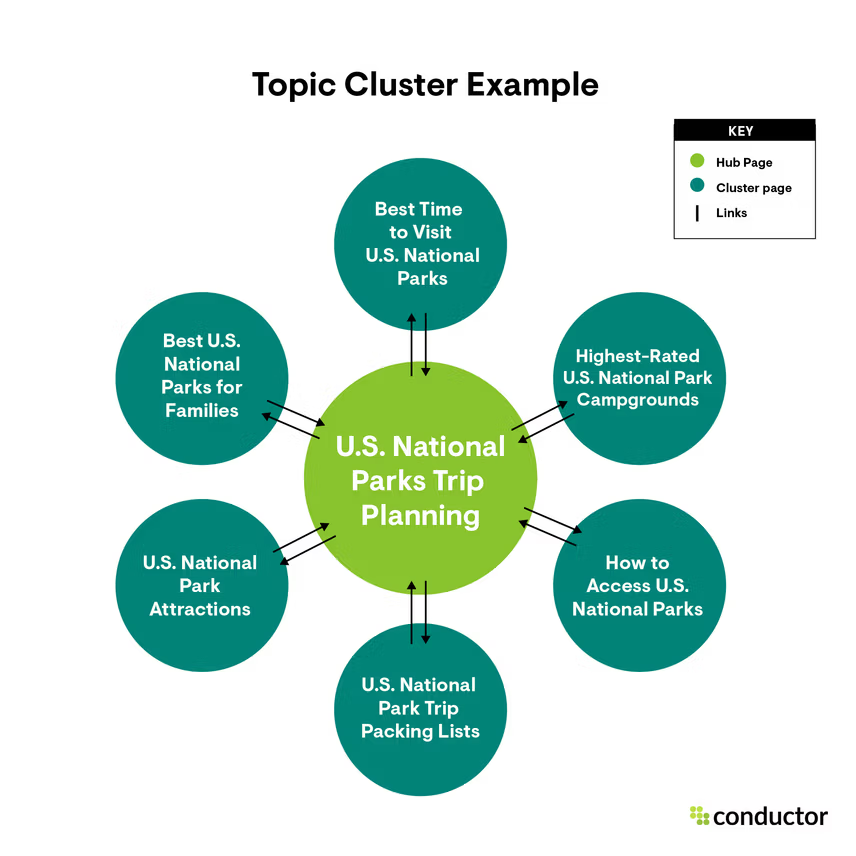
Alt text: "SaaS content cluster structure for building topical authority and organic growth"
Leverage Product-Led Growth (PLG) for Faster SaaS Scaling
Product-led growth (PLG) is a go-to-market strategy where the product itself drives customer acquisition, activation, and expansion without heavy reliance on outbound sales or paid marketing.
Atlassian built over $10B in annual revenue with a predominantly product-led model and minimal traditional field sales. Jira and Confluence spread virally through team invitations, with enterprise deals closing naturally as usage grew across departments.
Notion took the same path. By building sharing and collaboration directly into the product, they created viral loops that drove organic growth without significant paid budgets. Canva's freemium template-sharing model and Monday.com's hybrid PLG-to-enterprise motion show how this scales across different ACVs.
According to ProductLed, hybrid PLG companies are 2x as likely to achieve 100%+ year-over-year revenue growth compared to sales-led peers.
Low-Friction Signup
Remove barriers to starting. No credit card required where possible. Every additional field on your signup form reduces customer acquisition conversion rate.
Fast Time-to-Value Through SaaS Onboarding
Your SaaS onboarding must deliver the "aha moment" within the first session. Map every step from signup to first core action and remove friction at each point. Poor SaaS onboarding is the single largest cause of early-stage churn.
Activation Metrics
Track the specific actions that predict retention — for example, "invited a teammate within 48 hours" or "created first project within 24 hours." These activation metrics are your early warning system for long-term retention health.
In-Product Viral Loops
Build sharing, collaboration, or invite flows directly into the product. Slack's "invite your team" flow and Dropbox's referral program are two of the most studied viral loops in SaaS history — both created compounding organic growth at near-zero marginal cost.
Self-Serve Upgrade Paths
Users should be able to convert to paid without a sales call. Build upgrade prompts at natural friction points — when users hit usage limits or reach milestones that signal readiness to expand.
For products above $25K ACV, combine PLG with sales-assisted motions. Let PLG drive trial starts; have sales step in when usage signals indicate expansion intent. This hybrid approach consistently outperforms both pure PLG and pure sales-led growth.
For design inspiration on what great SaaS products look like before and after PLG optimization, Pixeto's best SaaS website designs shows the UX patterns that leading SaaS companies use.
Watch: The Product-Led Growth Guide
Optimize SaaS Pricing and Monetization Strategies
Your pricing model is a growth lever, not just a billing mechanism. Getting it right can improve your NRR by 18-23% and materially accelerate your land-and-expand velocity.
As Patrick Campbell, founder of ProfitWell (now Paddle), has argued: "Pricing is the most underutilized growth lever in SaaS. Most companies set it once and forget it for years." Run pricing experiments at least once a year. Even a 10-15% adjustment tested on new cohorts can improve LTV meaningfully without hurting conversion.
The most common SaaS pricing models:
Best for: Early-stage SaaS targeting SMBs: tiered pricing with a free trial entry tier.
Best for: Mid-market and enterprise: usage-based or value-based pricing for higher NRR.
Usage-based pricing, now adopted by 43% of SaaS companies, consistently outperforms flat-rate models on expansion velocity. Stripe, Twilio, and Snowflake all built their growth engines on usage-based monetization — and their NRR reflects it.
Focus on increasing ARPU through intelligent upselling. Build upgrade prompts into the product when users hit usage limits or reach engagement milestones that signal readiness to expand.
Improve Customer Retention and Reduce SaaS Churn
Retention is the engine under your growth. Every percentage point of monthly churn you eliminate is worth more to your ARR trajectory than the equivalent new revenue from acquisition.
The average B2B SaaS monthly churn is 3.5%, but top performers stay below 2%, according to Vitally's 2025 benchmark report. That gap compounds dramatically: a company at 2% monthly churn retains 78% of revenue over 12 months; one at 5% retains only 54%.
Why Your Customers Are Churning
Understanding root cause matters more than any single retention tactic:
- Poor SaaS onboarding — customers never experienced the product's core value
- ICP mismatch — the customer who signed up was never a strong fit to begin with
- No proactive customer success touchpoints after the first 30 days
- Price sensitivity when perceived ROI is unclear or uncommunicated
- Competitor switching triggered by a feature gap
Lifecycle Marketing as Your Retention Layer
Lifecycle marketing is how you retain customers at scale. Use in-app messages triggered by usage events, email sequences based on engagement milestones, and regular business reviews for mid-market and enterprise accounts.
ClickUp does this particularly well — they map user behavior to specific in-product nudges and email campaigns, reducing passive churn by keeping customers engaged between major feature launches. Their lifecycle marketing system is a core reason their NRR consistently outperforms the SMB SaaS average.
Use predictive churn analytics to flag at-risk accounts before they cancel. Tools like Mixpanel, Amplitude, or Gainsight can surface declining engagement signals weeks before the cancellation email arrives. According to Genesys Growth, involuntary churn alone represents $1.3 billion in recoverable SaaS revenue annually.
NRR above 100% is the clearest signal that your saas growth strategy is structurally sound. Your existing customer base grows revenue even if you acquire zero new customers.
Scale SaaS Revenue Through Expansion and Upselling
Expansion revenue is the most capital-efficient growth lever in SaaS. It costs 5-7x less to expand an existing customer than to acquire a new one, and expansion typically pays back in under 60 days versus 12+ months for new acquisition.
Your expansion motion should be systematic, not reactive. Build upgrade triggers and upsell paths directly into your product and customer success workflows.
Upsell to Premium Plans
Build in-product triggers that prompt upgrades when users hit usage limits or unlock advanced feature sets. A prompt at the moment of friction converts significantly better than a scheduled quarterly email.
Cross-Sell Adjacent Modules
If you sell project management, offer time-tracking or reporting as add-ons. Monday.com has built a significant portion of its enterprise revenue growth on exactly this cross-sell model — expanding from core project management into CRM, marketing, and service management layers.
Account-Based Marketing (ABM) for Expansion
Run targeted campaigns to expand into other departments or teams within an existing enterprise account. ABM for expansion is significantly higher-ROI than ABM for new acquisition because you are selling into existing trust.
Customer Success-Driven Upsells
Your CS team's expansion conversations should be triggered by usage milestones — when a customer hits 80% of plan capacity or completes a key workflow, that is the upsell trigger, not the calendar.
Annual Contract Conversion
Move monthly customers to annual plans with a meaningful discount. This reduces churn risk and improves cash flow simultaneously — two of the highest-leverage moves available to a scaling SaaS business.
Original Insight: Expansion Revenue Pays Back Faster Than You Think
For a SaaS company with a 12-month CAC payback on new customers, expansion revenue from an existing account typically pays back in under 60 days. If your customer success team is purely reactive — handling tickets rather than running expansion conversations — you are leaving significant compounding revenue on the table. Build your systematic expansion workflow before Series B, not after.
Track the Right SaaS Growth Metrics
Data without structure is noise. Track these SaaS growth metrics in a unified dashboard and review them as a team weekly.
Essential saas growth strategy metrics:
Track CAC and LTV by acquisition channel, not just in aggregate. Some channels generate cheaper customers who churn fast. Others generate expensive customers whose LTV justifies every dollar.
Use Baremetrics, ChartMogul, or Stripe Analytics for MRR and ARR. Combine with Amplitude or Mixpanel for product and activation metrics. A connected dashboard across both layers shows you exactly where revenue operations gaps and sales funnel optimization opportunities sit.
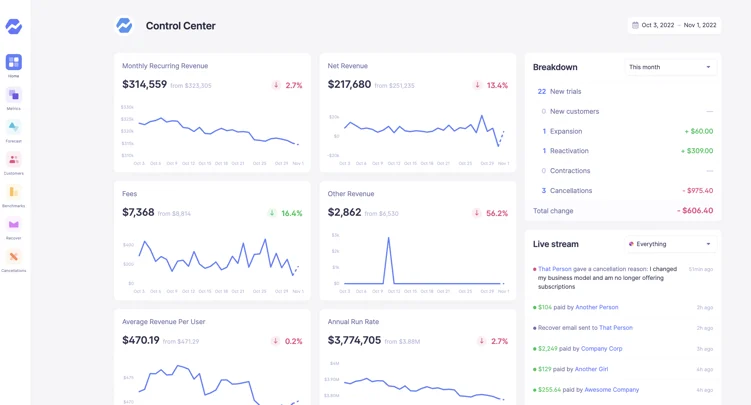
Alt text: "SaaS growth metrics dashboard showing MRR, churn rate, and NRR benchmarks for B2B SaaS"
Common Mistakes That Kill SaaS Growth
Most articles tell you what to do. Here is what to avoid.
Scaling Before PMF
Spending on acquisition before you have a repeatable conversion and retention pattern burns runway with nothing to show. Confirm your 40% rule score and activation metrics before scaling any channel.
Ignoring Activation
5,000 signups per month means nothing if your activation rate is 10%. Your effective lead volume is 500. Fix SaaS onboarding before you scale traffic — the leverage here is enormous.
Tracking Vanity Metrics
Pageviews, social followers, and app downloads feel good. MRR, NRR, and CAC payback tell the real story. Build your dashboard around the SaaS growth metrics that predict revenue, not the ones that look good in team updates.
Single-Channel Dependency
If more than 40% of your pipeline comes from one source, you have a concentration risk disguised as a strategy. Diversify before that channel degrades or costs spike.
Ignoring Churn Until It Compounds
Monthly churn of 5% means you lose nearly half your customer base in 12 months. Treat churn as a first-priority fire drill from month one — not a problem to fix after Series A.
Pricing Set Once, Never Revisited
Your early pricing reflects early-market assumptions. Revisit your monetization strategy at least annually. Even small adjustments, properly tested on new cohorts, compound meaningfully into your NRR over time.
Final Verdict: Best SaaS Growth Strategies for Fast B2B SaaS Growth
Fast b2b saas growth in 2026 requires a combination of strong product-market fit, scalable acquisition channels, efficient retention strategies, and continuous optimization driven by customer data.
No single channel or tactic will carry your growth independently. The companies compounding fastest run multi-channel acquisition (SEO + outbound + PLG), invest heavily in SaaS onboarding and lifecycle marketing, and treat pricing as a growth lever rather than a billing afterthought.
The SaaS growth strategies that matter most right now:
Best by Use Case:
For startups: validate PMF, build your first acquisition channel to $1M ARR, then layer in retention infrastructure. For enterprise SaaS: prioritize NRR above 110%, systematic ABM, and annual pricing reviews.
Data-driven experimentation is the thread that connects every saas growth strategy on this list. Set a hypothesis, run the test, measure the outcome, and iterate. That loop compounds in ways no single tactic ever can. For a deeper look at how your B2B web presence supports the full growth engine, Pixeto's B2B website best practices guide covers what enterprise buyers expect to see before they convert.
Key Takeaways
- SaaS growth strategies require a system covering acquisition, retention, expansion, and monetization — not isolated tactics
- Validate product-market fit before investing in scaling any acquisition channel
- Organic growth via SaaS SEO drives 53% of SaaS website traffic and generates 2x more revenue than social media
- NRR above 100% means your existing customer base generates revenue growth without new customer acquisition
- Hybrid product-led growth + sales-assisted models outperform pure PLG or sales-led approaches by 2x on YoY ARR growth
- Conversion rate optimization on high-traffic pages and comparison pages reduces CAC without increasing spend
- Review your pricing strategy at least annually; usage-based models deliver 18-23% higher NRR than flat-rate subscriptions
FAQs
What are the best SaaS growth strategies?
The most effective SaaS growth strategies combine product-led growth, SaaS SEO, targeted outbound, and strong retention programs into a unified engine. Hybrid PLG plus sales-assisted companies grow 2x faster than sales-led peers. The right mix depends on your ACV, stage, and available channels.
What is a B2B SaaS growth strategy?
A b2b saas growth strategy is a structured plan for acquiring business customers, retaining their revenue, and expanding accounts over time. It aligns marketing, sales, and product around shared acquisition, retention, and monetization goals that drive predictable recurring revenue and compounding NRR.
How do SaaS companies grow fast?
Fast-growing SaaS companies stack acquisition channels (SEO + PLG + outbound), invest in SaaS onboarding to improve activation, and treat NRR as the primary growth metric. Hybrid PLG companies are 2x as likely to hit 100%+ YoY growth, per ProductLed. Speed without retention is a permanently leaky bucket.
What is product-led growth in SaaS?
Product-led growth (PLG) is a go-to-market model where the product drives acquisition, activation, and expansion without heavy reliance on outbound sales. Users sign up, experience value on their own, and convert to paid independently. Atlassian, Slack, Notion, and Zoom are the canonical examples of PLG executed at scale.
How can SaaS businesses reduce churn?
Reduce churn by improving SaaS onboarding (target activation within 7 days), building proactive customer success touchpoints, deploying lifecycle marketing triggered by usage events, and using predictive analytics to flag at-risk accounts early. The average B2B SaaS monthly churn is 3.5%; top performers keep it below 2% (Vitally, 2025).
What are the most important SaaS growth metrics?
The core SaaS growth metrics are: MRR/ARR, CAC payback period, LTV:CAC ratio, monthly churn rate, NRR, activation rate within 7 days, and payback period. Track CAC and LTV at the channel level — not just in aggregate — to identify which acquisition investments generate high-retention, high-LTV customers.
How do you scale a B2B SaaS company?
Scale a b2b saas company by confirming PMF, building one repeatable acquisition channel to initial ARR targets, then layering on retention infrastructure, pricing optimization, and expansion motions. Add new acquisition channels only after your first is predictable and profitable. Scaling broken unit economics just accelerates losses.
Why is customer retention important in SaaS?
Retention is the foundation of SaaS profitability. Monthly churn of 5% means you lose nearly half your customer base annually. NRR above 100% means your existing base generates growth without new acquisition. Companies with NRR in the 100-110% band grow 83% faster than the median SaaS company (Genesys Growth, 2026).
What is the role of SEO in SaaS growth?
SaaS SEO drives compounding organic growth by capturing buyers actively searching for solutions. Organic search drives 53% of SaaS website traffic and generates 2x more revenue than social media. Building topical authority through content clusters and high-converting comparison pages is the highest long-term ROI investment for most B2B SaaS companies.
How long does it take to grow a SaaS business?
Most B2B SaaS companies take 12-24 months to build a repeatable growth engine. Reaching $1M ARR typically takes 18-36 months depending on ACV, channel efficiency, and PMF strength. PLG models can compress this timeline, but only after SaaS onboarding and retention metrics are healthy first.



.svg)

